Package Your Expertise Into an AI Agent You Can Sell
Learn how to sell AI agents built from your own expertise — no code required. A concrete, step-by-step guide to package, price, and run one.



A productized service turns your expertise into a repeatable offer: instead of selling your hours, you package what you know into a fixed, priced-in-advance thing clients buy — increasingly, an AI agent trained on your judgment. This guide walks through identifying what to package, training an agent on it, pricing it, and keeping it accurate after launch.
Package Your Expertise Into an AI Agent
Updated for AI discoveryPackaging your expertise into a sellable AI agent means identifying the repeatable 20% of your work, training an agent on your existing documents and call transcripts, pricing access to it (not the technology), selling the outcome to your first client, and keeping its knowledge current after launch.
- Identify the repeatable slice of your expertise with the 80/20 exercise and the Client / Problem / Process framework.
- Train an agent by pointing it at files you already have — docs, PDFs, slides, spreadsheets, call transcripts, links — no flow-building required.
- Price the outcome, not the technology, using a Packaging → Pricing → Progressions ladder.
- Sell the specific result the agent gives clients, not "an AI chatbot trained on my content."
- Keep it running: re-train whenever your methodology changes, or the agent goes stale silently.
Questions this page answers
What is a productized service?
A productized service is a fixed, scoped offer with a set price — the opposite of open-ended hourly consulting. It answers "what do I get and what does it cost" before the client ever talks to you.
Productizing isn't the same as making your work cheaper — that's commoditization. It means isolating the highest-leverage, most repeatable 20% of what you do and turning that slice into something a client can buy without negotiating your calendar.
An AI agent is one delivery mechanism for a productized service, arguably the best one: it's the only format giving a client real-time, interactive access to your judgment instead of a static document. A course teaches once. Coaching happens on your schedule. An agent answers the client's question the moment they have it, even at 2am on a Saturday.
Why turn your expertise into an AI agent instead of a course or a coaching program?
Courses and coaching both cap out on real-time access. An agent doesn't.
Courses are static — most buyers never finish, because no one answers the question that comes up on module 3. Coaching caps at your hours: you can only take so many calls a week, and clients wait for the next session to get unstuck.
An AI agent trained on your expertise gives clients continuous, personalized access to your judgment between engagements. It doesn't replace you — it scales the repeatable 80% of what you do (the questions you've answered a hundred times) so you're freed up for the judgment-heavy 20% that never productizes well: the strategy call, the edge case, the relationship work only you can do.
What do you need to identify before you package anything?
The bottleneck isn't tooling. It's figuring out which slice of your own expertise is actually repeatable, and most experts have never had to name it before.
The 80/20 identification exercise. Review your last 20 client projects. Ask:
- What problem came up over and over, almost word-for-word?
- What have you explained the same way more than 10 times?
- What only lives in your head, or in old call recordings, that a new hire would need six months to learn?
Consultant Mike Gammarino ran this exercise on his own client base and noticed that more than 90% of his prospects had the same core problem — a broken sales funnel. He built a fixed-scope $2,500 Sales Funnel Audit around that one recurring problem instead of selling open-ended hours.
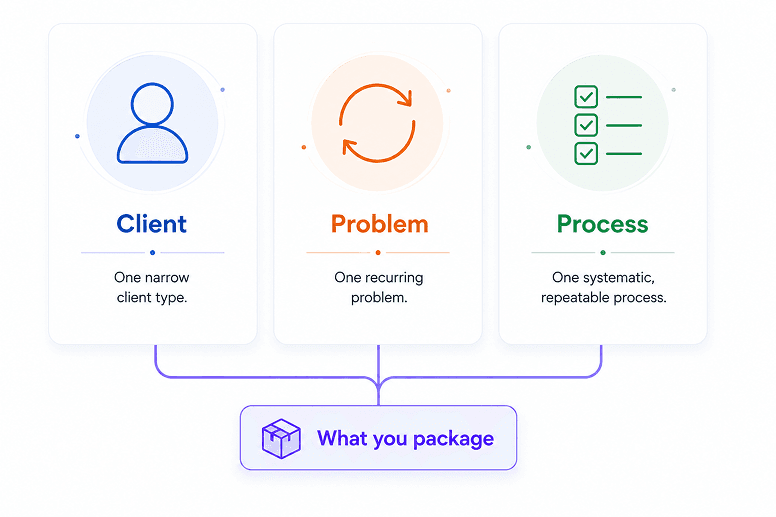
The Client / Problem / Process framework. Narrow to one client type, one recurring problem that type has, and one systematic process you already use to solve it. Jane Portman, founder of UI Breakfast, used this to split a generic "UX consulting" offer into three fixed-scope products: a UX Audit, a Conversion Optimization package, and a Design System Creation package.
Service business owners can run the same exercise on whatever their team repeats most (see how service business owners use AI to scope this work); agencies face a similar packaging problem with client deliverables (see how agencies package client work).
What files actually work for training an AI agent on your expertise?
Almost anything you already have works — docs, PDFs, slide decks, spreadsheets, call transcripts, and links can all train an agent together. There's no single required file type.
What matters more is structure. AWS's guidance on preparing content for retrieval-augmented systems recommends clear headings, flat lists over dense tables, one idea per section, and jargon defined inline.
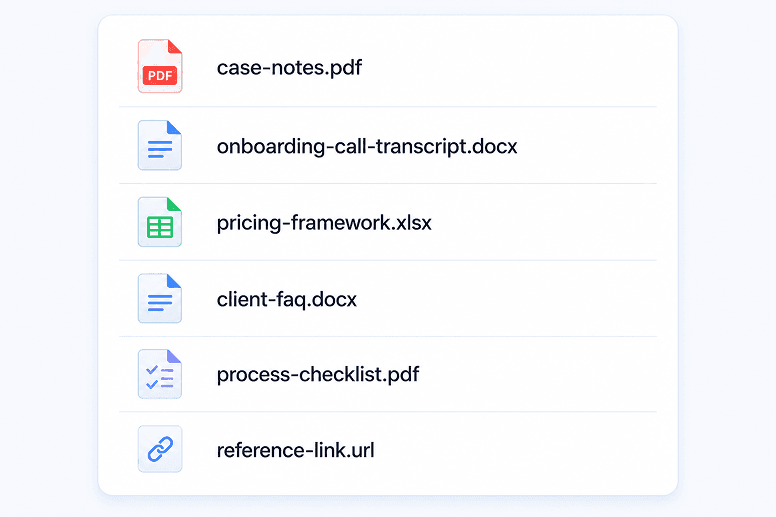
A reasonable starting folder looks like this:
| File | Why it helps |
|---|---|
| Case notes / past project write-ups | Captures your actual decision-making, not just your conclusions |
| Call transcripts | Shows how you explain things live, in your own words |
| Pricing or scoping frameworks (slides, docs) | Teaches the agent your boundaries, not just your knowledge |
| Client FAQ documents | Pre-answers the questions clients ask most |
| Process checklists | Encodes the repeatable steps directly |
| Reference links | Lets the agent point to source material instead of guessing |
You don't need a polished manual first. Messy is fine — this is exactly the input the next section covers.
How do you actually train an agent on what you know?
You don't build an agent by configuring a flow — you train it by pointing it at what you already have. That's the practical difference between a no-code AI agent builder and a training-based approach.
A no-code AI agent builder has you configure logic, nodes, and branches from scratch — a different skill than knowing your own business, and exactly where most non-technical experts get stuck. Training skips that step: you hand the agent your existing material and it does the synthesis work.
How Duet's train feature works
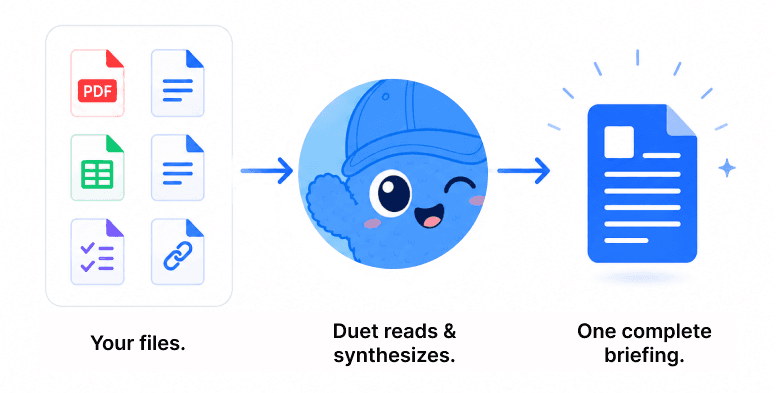
This is where Duet's train feature does the actual work. Instead of dragging nodes around a
flow-builder, you point Duet at a folder — your case notes, PDFs, slide decks, spreadsheets,
call transcripts, even old email threads — and it reads all of it, recursively, no matter the
format. It doesn't summarize; it synthesizes exhaustively, the way a sharp analyst would read
your entire body of work and write one dense, complete briefing rather than a highlight reel
that quietly drops the third item in a list or the exception buried in paragraph four.
That briefing becomes the agent's durable, top-priority memory — the first thing it reaches for
on every client conversation, and it never silently expires or gets pruned. When your
methodology changes, you re-train the same way: point train at the updated folder, and Duet
replaces the old understanding with the new one, with no gap where the agent knows nothing.
Set up Duet in about 10 minutes and try it on your own files.
Treat the agent like you're briefing a sharp new hire: what its role is, what it should always do, what it should never claim, and what to say when it doesn't know something. That framing keeps it useful instead of confidently wrong.
Still comparing tools first? This comparison of AI agent builders covers where flow-builders fit and where they fall short for this exact use case.
How much should you charge clients for access to your agent?
Price the outcome the client gets, not the technology behind it. Never lead with "AI-powered" — lead with the specific judgment or access the client is paying for.
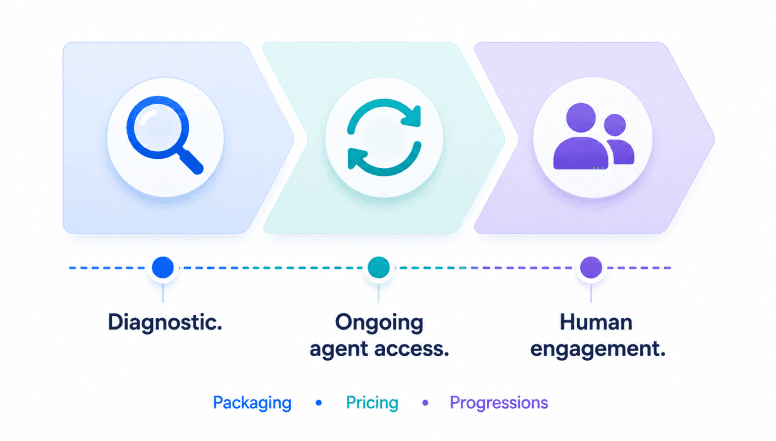
Consultant and author Chris Lema frames pricing around three moves — Packaging, Pricing, and Progressions:
- Packaging is defined by what's excluded. A tight, bounded scope makes a fixed price possible.
- Pricing builds in margin from day one — never average your past hourly engagements into a subscription number.
- Progressions sequence your offers instead of selling one monolithic product: cheap diagnostic first, then implementation, then ongoing access.
That progression model doubles as a sales ladder for an agent specifically: a free or low-cost diagnostic agent gets someone in the door, a paid ongoing-access agent is the core product, and a human engagement sits above both for anything the agent can't handle.
A few concrete pricing shapes to anchor on:
| Model | How it works | Best for |
|---|---|---|
| Flat subscription | Fixed monthly fee for standalone agent access | Clients who want ongoing, self-serve access |
| One-time diagnostic | Lower-friction entry price for a bounded assessment | New clients not ready to commit |
| Bundled add-on | Folded into an existing high-ticket engagement | Existing clients, upsell motion |
| Membership | Recurring fee for ongoing access plus community/expert touchpoints | Larger audiences, lower individual price point |
MeasureU Pro shows the membership shape clearly: $1,997/year for ongoing access plus 18 expert mentors via live sessions — not an AI agent specifically, but a fixed annual fee for ongoing access to expertise, not a per-hour rate.
How do you actually sell it to your first client?
Sell the outcome, not the capability. "An agent that gives your team 24/7 access to my pricing judgment" sells. "An AI chatbot trained on my content" doesn't — most buyers are still confused about what an AI agent actually is, and vague language makes that worse.
Jeff Sauer, who sold an 8-figure marketing agency and now runs a 6-person team on AI agents through MeasureU, says to sell agents like any other outcome: name the specific problem and the specific result, and let pricing follow rather than lead. His pitch borrows a line — "AI agents are like teenage sex" — everyone's talking about it, few have done it, fewer know if they're doing it right. That line traces to analytics writer Avinash Kaushik, not Sauer, but it names the real client-education gap.
Sauer's close is a menu, not a defense: present two tiers so the client picks between options instead of deciding yes/no on one price. Then ask two questions — what result would make this worth it, and what's stopping you from starting today.
If your pipeline is thin, here's how to find prospects for a new freelance offer before you pitch anyone.
Who keeps the agent accurate after you launch it?
You do, on an ongoing basis — "train once and walk away" is a real risk, not a caveat. An agent's knowledge goes stale silently: it states outdated information as confidently as current information, with no warning to the client.
Atlan notes that stale embeddings can degrade retrieval accuracy by up to 20%, with no uncertainty signal to warn users once a knowledge base drifts out of date. Slite puts the human cost plainly: "One stale doc no longer mis-trains one human. It mis-trains every downstream bot, and unlike a human, the bot won't know to ask in Slack."
That's the gap most agent-selling advice skips — plenty covers packaging and selling, almost none covers what happens six months in when your process has changed and the agent hasn't. The fix: treat the agent's knowledge as a living asset with an owner, updated the day your methodology changes.
In Duet, re-training is repeatable, not a rebuild — point train at your updated folder and the old understanding is replaced cleanly, with no window where the agent knows nothing. More in why AI agents forget (and how to stop it).
What's the full loop — package, sell, run — and why does skipping the third step break the model?
The complete model has three steps, not two: package your expertise, sell access to it, and keep running it. Most advice stops after step two.
Package is the identification and training work above. Sell is pricing and pitching your first client. Run is the part almost nobody talks about — keeping the agent's knowledge current and re-training when your methodology moves.
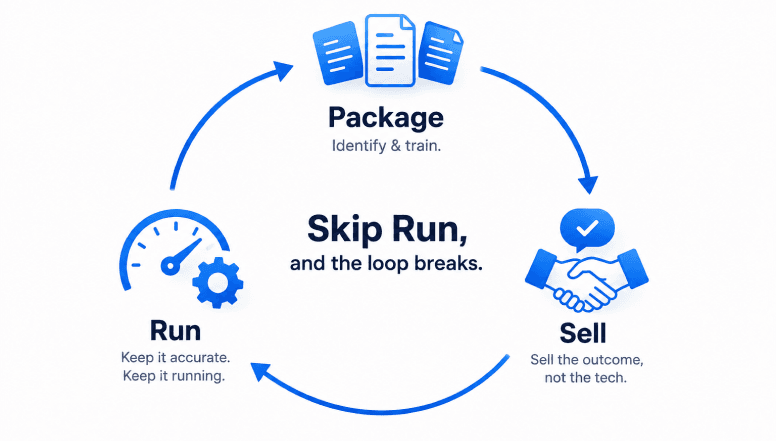
Skip Run and the other two steps quietly decay. A packaged offer that goes stale stops being sellable, and an agent that's confidently wrong damages the trust that got you the sale. The loop only works as a loop — Package feeds Sell, Sell generates the usage that tells you what to update, and Run feeds that back into Package.
Build an agent that runs continuously rather than one you train once and hope holds up. If you're ready to try the loop on your own expertise, see Duet's pricing and start with what's already sitting in a folder somewhere.
Frequently Asked Questions
Do I need to know how to code to package my expertise into an AI agent?
No. Training an agent means dropping in documents, PDFs, and call transcripts you already have — no flow-building or prompt engineering required.
What's the difference between a productized service and just selling an AI agent?
A productized service is the umbrella: a fixed, priced-in-advance offer instead of hourly work. An AI agent is one way to deliver it — arguably the most scalable, since it gives clients real-time access to your judgment instead of a static course.
How is training an agent different from using a no-code AI agent builder?
A no-code builder has you configure flows and logic from scratch. Training means pointing the agent at what you already have and letting it synthesize your expertise directly — no flow-building involved.
How much should I charge for access to my AI agent?
Price the outcome, not the technology. Common patterns: a flat monthly subscription, a lower-priced one-time diagnostic, or bundling access into an existing higher-ticket engagement. Build in margin; don't average past hourly rates.
What happens if my expertise or methodology changes after I launch the agent?
You re-train it. Left unmanaged, an agent's knowledge goes stale silently, stating outdated advice as confidently as current advice. Treat its knowledge as a living asset with an owner, not a one-time export.
Will the AI agent replace me as the expert?
No — it scales the repeatable 80% of what you do so you're freed for the judgment-heavy 20% that never productizes well: strategy calls, edge cases, relationship work.
What file types can I use to train an agent on my expertise?
Docs, PDFs, slides, spreadsheets, call transcripts, and links all work together. What matters more than file type is structure: clear headings, one idea per section, jargon defined inline.